Barnard's Loop
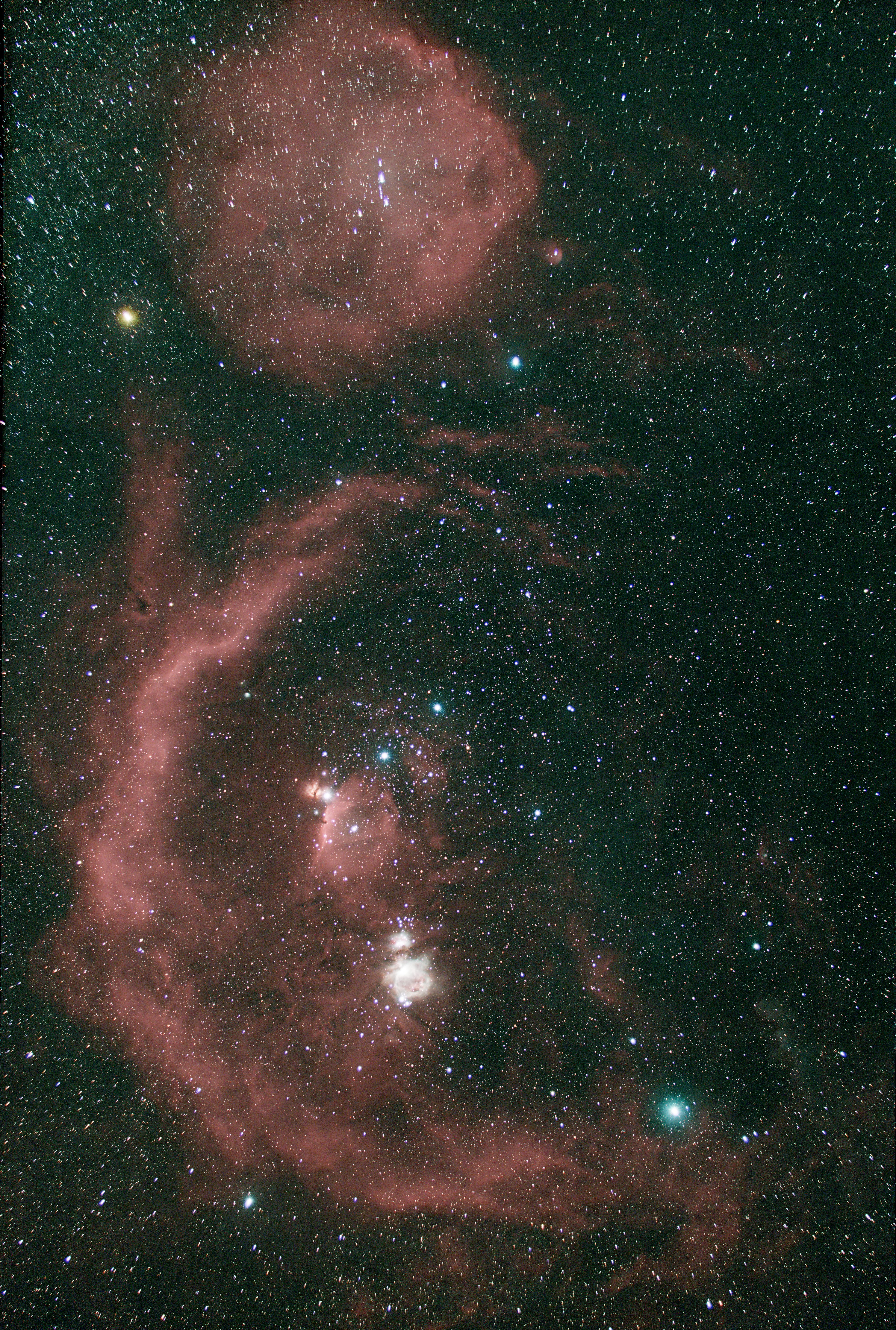
The stars of Orion are an unmistakable sight in the winter
skies. In this image the 3 stars of Orion's belt run diagonally at the center. Below the left hand star, Alnitak, his sword is formed by the line of stars and nebulosity. The Great Nebula in Orion can be seen near the tip of the sword and the famous Horsehead Nebula is visible as a small dark notch in the nebulosity near Alnitak. The bright reddish star at top left is Betelgeuse which marks Orion's shoulder.
Orion is also home to a large complex of nebulosity dominated by a 10° diameter arc known as Barnard’s Loop. The brightest parts of it are only barely detectable to a keen-eyed visual observer under the very best of conditions and its full extent was discovered photographically. Many of the brighter stars in this image belong to the Orion OB1 association which is a collection of hot, short-lived giant stars. It has been estimated that 10-20 supernovas exploded in this region within the last 12 million years and Barnard’s Loop is likely a bubble blown out by one of them. At the top of the image, where Orion's head would be, is the Lambda Orionis Ring (Sh2-264) sometimes called the Angelfish Nebula. It may also be a supernova remnant. The field of view is 17.3°×25.7°. For scale the disk of the Full Moon has been superimposed at top right.