Great Nebula in Andromeda (M31)
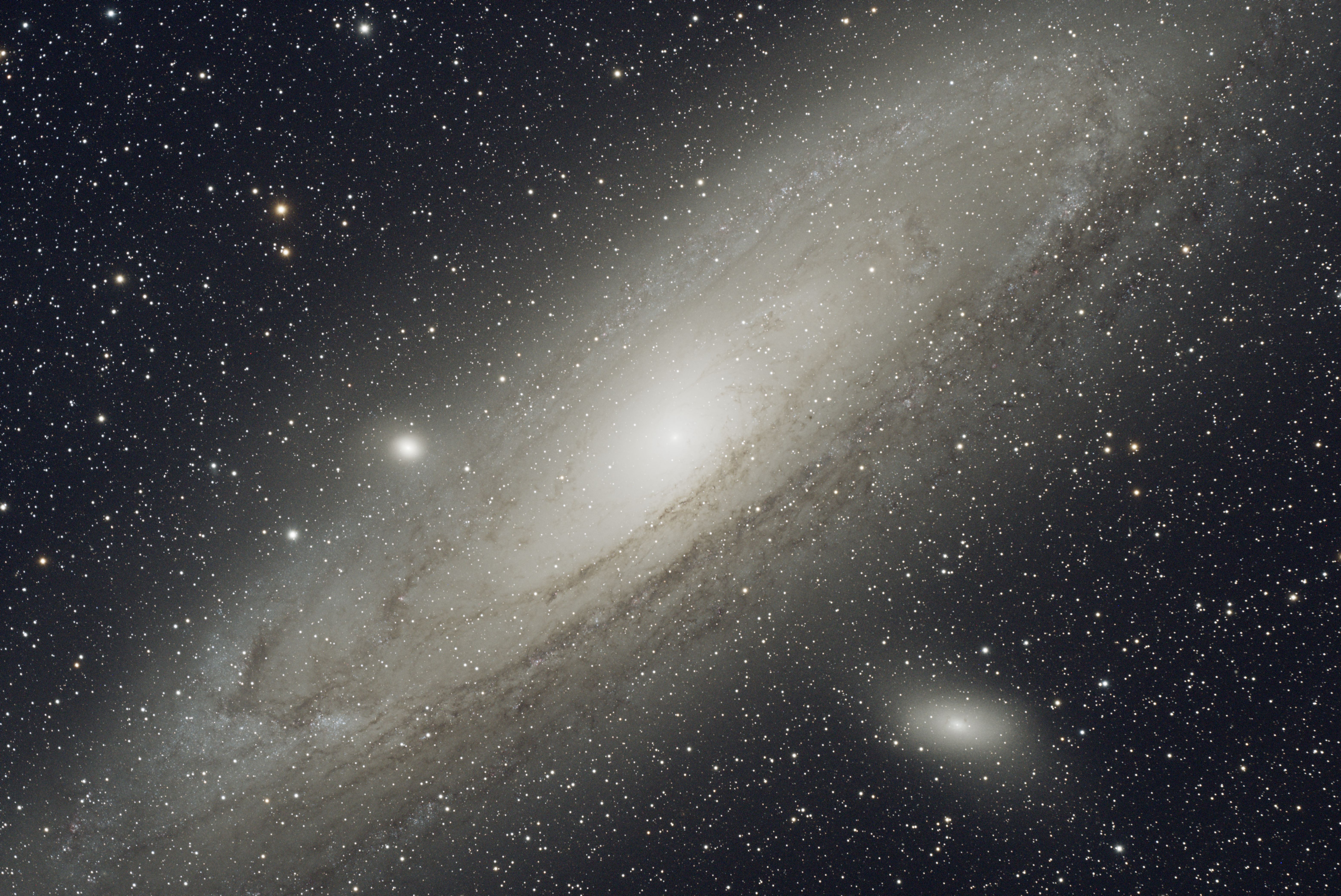
The Great Nebula in Andromeda or Messier 31 is a spiral galaxy, similar in structure to our own Milky Way Galaxy and the Triangulum Galaxy but tilted at an angle of just 12.5° from edge on. It is easily seen as an elongated fuzzy patch with the naked eye under the dark skies of Eustis.
The Andromeda Galaxy is a member of our Local Group of galaxies which includes the Milky Way and the Triangulum Galaxy. It is accompanied by a number of satellite galaxies that orbit around it. Two of these, Messier 32, and Messier 110 can be seen in the image above to the left and below to the right respectively of the bright compact galactic nucleus. Two of Andromeda's other satellites are Caldwell 17 (NGC 147) and Caldwell 18 (NGC 185).
The Andromeda Galaxy is estimated to weigh 1 trillion solar masses which is similar to the Milky Way. It is heading towards us at 300 km/s (186 miles per second) and is expected to collide in 4-5 billion years. At that time the stars of the two galaxies will engage in an intricate dance possibly ending in the formation of a single elliptical galaxy.
The overall glow of the galaxy comes from the combined light of unresolved stars. Looking closely at Andromeda's edges, particularly near the lower left tip, it is possible to discern individual stars. Despite lying at a distance of 2.5 million light years, these stars are bright enough to be seen individually across the gulf. These regions are OB associations of which Double Cluster in Perseus is an example within our own Milky Way.
This image is a 2 hour total exposure taken through a 5 inch telescope on October 22nd, 2022 from Eustis Ridge.
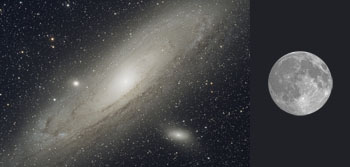
For scale the image below shows the Andromeda Galaxy beside the disk of the Full Moon.